
How Does a Residential Modular House Support Circular Economy?
The construction industry is one of the largest consumers of raw materials and one of the largest producers of waste. Traditional buildings are designed for a linear economy: materials are extracted, processed, assembled, and eventually demolished and sent to landfill. The circular economy offers a different vision. In a circular economy, materials are kept in use for as long as possible, and at the end of their service life, they are recovered, recycled, or reused. The Residential Modular House is a building typology that is inherently aligned with circular economy principles. Unlike a conventional house, which is built to be permanent, a Residential Modular House is designed to be assembled, disassembled, and reassembled. Its components are prefabricated in a factory, transported to the site, and connected together. When the house is no longer needed at one location, it can be taken apart and moved to another. This design philosophy transforms the house from a permanent asset into a reusable product.
The question of how a Residential Modular House supports the circular economy is answered by its design, its materials, and its lifecycle. The modular design allows for disassembly, which means that the components can be reused or recycled at the end of the building's life. The factory-based construction process reduces waste and allows for precise material usage. The materials used in a Residential Modular House can be selected for their recyclability and their low environmental impact. And the lifecycle of the house can be extended through renovation, expansion, or relocation. This article will examine these factors in detail, providing a comprehensive analysis of how Residential Modular Houses contribute to the circular economy. We will also provide detailed specifications for our Residential Modular House products from our factory at Shanghai Cymdin Industrial Co., Ltd.
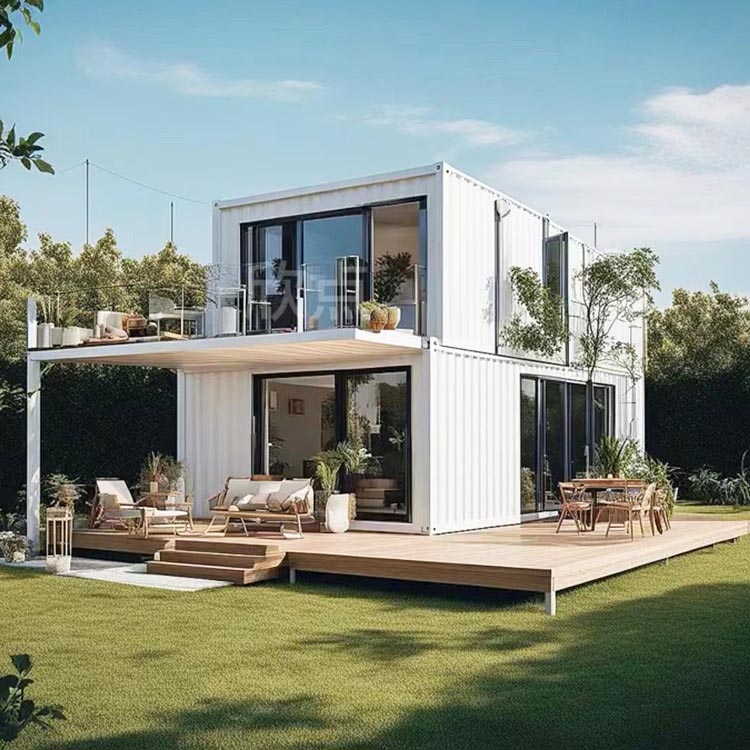
Table of Contents
- 1. What Is a Residential Modular House and How Is It Built?
- 2. How Does Design for Disassembly Enable Material Recovery?
- 3. Why Does Factory Construction Reduce Material Waste?
- 4. What Materials in a Modular House Support Circularity?
- 5. How Does Relocation Extend the Life of a Modular House?
- 6. What Are the Key Specifications of a Residential Modular House?
- 7. Frequently Asked Questions (FAQ)
- 8. Conclusion
1. What Is a Residential Modular House and How Is It Built?
A Residential Modular House is a dwelling that is constructed from prefabricated modules or sections. The modules are manufactured in a factory, complete with framing, insulation, wiring, plumbing, and interior finishes. They are then transported to the building site and assembled into a complete house. The modules can be stacked, connected side by side, or arranged in a variety of configurations to create different floor plans. The construction process is fundamentally different from traditional site-built construction. In traditional construction, the building is assembled piece by piece on the site, with different trades working in sequence. In modular construction, the building is assembled in a factory, where the work can be done in parallel, under controlled conditions, and with a high degree of precision. The table below compares the key characteristics of modular and traditional construction.
| Characteristic | Modular Construction | Traditional Construction |
| Construction Location | Factory | Site |
| Construction Time | 30-50% faster | Standard |
| Material Waste | Low (5-10%) | High (20-30%) |
| Quality Control | High (factory conditions) | Variable (weather, labor) |
| Design for Disassembly | Inherent | Difficult |
| Relocatability | Yes | No |
At Shanghai Cymdin Industrial Co., Ltd., our factory specializes in the design and manufacture of Residential Modular Houses. We use advanced production techniques and high-quality materials to create houses that are durable, comfortable, and sustainable. Our modular houses are designed for easy assembly and disassembly, making them ideal for circular economy applications. Whether you need a single-family home, a multi-unit development, or a temporary housing solution, we can provide a modular house that meets your requirements.
2. How Does Design for Disassembly Enable Material Recovery?
Design for disassembly is the practice of designing a product so that it can be taken apart at the end of its life, allowing the components and materials to be recovered and reused. In a Residential Modular House, design for disassembly is not an afterthought; it is a fundamental design principle. The house is assembled from modules that are connected together using mechanical fasteners, such as bolts, clamps, and connectors. These connections can be reversed, allowing the modules to be separated without damaging them. Within each module, the interior finishes and services are designed to be accessible and replaceable. This means that at the end of the house's life, the modules can be separated, and the materials can be recovered. The table below summarizes the design for disassembly features of a Residential Modular House and the material recovery benefits.
| Design Feature | Disassembly Method | Material Recovery Benefit |
| Mechanical Connections | Bolts, clamps, connectors | Modules can be separated without damage |
| Accessible Services | Removable panels | Wiring and plumbing can be removed and recycled |
| Layered Construction | Separable layers | Materials can be sorted for recycling |
| Modular Interior | Removable partitions | Interior components can be reused |
| Standardized Components | Interchangeable parts | Components can be reused in other buildings |
At our factory, we design our Residential Modular Houses for disassembly from the very beginning. We use standardized connections and components that can be easily separated. We also document the disassembly process, providing our customers with the information they need to recover materials at the end of the building's life. This commitment to design for disassembly is one of the key ways in which our Residential Modular Houses support the circular economy.
3. Why Does Factory Construction Reduce Material Waste?
Material waste is a significant problem in traditional construction. Studies have shown that 20-30% of the materials delivered to a construction site are wasted due to damage, over-ordering, and offcuts. In a factory, the situation is different. The factory environment is controlled, so materials are protected from the weather. The production process is highly optimized, so materials are cut to precise dimensions and used efficiently. And the waste that is generated is separated and recycled. The result is a material waste rate of 5-10%, compared to 20-30% for traditional construction. This reduction in waste is a direct contribution to the circular economy, as it reduces the demand for new materials and the amount of waste sent to landfill. The table below compares the material waste rates of modular and traditional construction.
| Material | Modular Construction Waste Rate | Traditional Construction Waste Rate |
| Timber | 5% | 20% |
| Steel | 3% | 15% |
| Concrete | 2% | 10% |
| Insulation | 4% | 25% |
| Drywall | 6% | 30% |
| Overall Average | 5-10% | 20-30% |
At Shanghai Cymdin Industrial Co., Ltd., our factory is equipped with advanced machinery and a comprehensive waste management system. We use computer-controlled cutting and forming equipment to minimize offcuts. We separate our waste streams and recycle as much as possible. And we work with our suppliers to reduce packaging waste. Our goal is to minimize the environmental impact of our production process and to maximize the circularity of our Residential Modular Houses.
4. What Materials in a Modular House Support Circularity?
The materials used in a Residential Modular House can be selected to support circularity. The key criteria for a circular material are: it is renewable or recycled, it is durable, it is recyclable at the end of its life, and it is non-toxic. The table below summarizes the circularity characteristics of common building materials used in modular houses.
| Material | Renewable | Recycled Content | Recyclable | Circularity Rating |
| Steel Frame | No | High (up to 90%) | Yes (infinitely recyclable) | High |
| Timber Frame | Yes (if FSC certified) | Low | Yes (biodegradable, reusable) | High |
| Mineral Wool Insulation | No | High (up to 70%) | Yes | Medium-High |
| Gypsum Board | No | Moderate | Yes (recyclable) | Medium |
| Aluminum Cladding | No | High | Yes (infinitely recyclable) | High |
| Concrete | No | Moderate | Limited | Low |
At our factory, we work with our customers to select materials that support circularity. We offer steel-framed and timber-framed modular houses, both of which have high circularity ratings. We use insulation with high recycled content and low environmental impact. We use cladding and finishes that are durable and recyclable. And we avoid materials that are difficult to recycle or that contain toxic substances. Our goal is to create Residential Modular Houses that are not only comfortable and beautiful but also environmentally responsible.
5. How Does Relocation Extend the Life of a Modular House?
One of the most powerful ways in which a Residential Modular House supports the circular economy is through relocation. Because the house is designed for disassembly, it can be taken apart and moved to a new location. This means that the house can be used for a different purpose or in a different place, extending its useful life. For example, a modular house that was used as a temporary office can be relocated and converted into a residence. A modular house that was used for student housing can be relocated to a site where it is needed for family housing. The ability to relocate the house means that it does not become obsolete when the original need has passed. It can be repurposed and reused, keeping the materials in use for much longer than a traditional building. The table below summarizes the lifecycle extension benefits of modular house relocation.
| Scenario | Traditional House | Residential Modular House |
| Change of Use | Major renovation required | Modules reconfigured or relocated |
| Relocation | Not feasible | Disassemble, transport, reassemble |
| Expansion | Site construction required | Add new modules |
| End of Life | Demolition and landfill | Disassembly and material recovery |
| Expected Service Life | 50-100 years (single use) | 50+ years (multiple uses) |
At Shanghai Cymdin Industrial Co., Ltd., we design our Residential Modular Houses for relocation. We use durable materials and robust connections that can withstand multiple assembly and disassembly cycles. We also provide our customers with the documentation and support they need to relocate their modular houses. This focus on relocation is a key differentiator of our products and a major contributor to their circularity.
6. What Are the Key Specifications of a Residential Modular House?
The key specifications for a Residential Modular House include the module dimensions, the structural system, the insulation, the finishes, and the services. The table below provides a summary of the typical specifications for our Residential Modular Houses.
| Specification | Options | Notes |
| Module Dimensions | 3m x 6m, 3m x 9m, 3m x 12m | Custom sizes available |
| Structural System | Steel frame, Timber frame | Selected based on application |
| Insulation | Mineral wool, PIR, EPS | Selected based on climate |
| Exterior Finish | Metal cladding, Fiber cement, Timber | Selected based on aesthetics |
| Interior Finish | Gypsum board, Plywood, MDF | Selected based on budget |
| Windows and Doors | Aluminum, PVC, Timber | Double or triple glazed |
| Electrical and Plumbing | Pre-installed in factory | Quick connection on site |
| Assembly Time | 1-3 days per module | Depends on site conditions |
| Design Life | 50+ years | With proper maintenance |
At our factory, we manufacture Residential Modular Houses to meet these specifications and more. We can customize the dimensions, the structural system, the finishes, and the services to suit your specific requirements. Our engineering team can work with you to design a modular house that meets your needs and supports your circular economy goals.
7. Frequently Asked Questions (FAQ)
Question 1: How does a residential modular house support the circular economy?
Answer: A Residential Modular House supports the circular economy through design for disassembly, which allows the components and materials to be recovered and reused at the end of the building's life. It also reduces material waste through factory construction, uses materials that are recyclable and renewable, and can be relocated to extend its useful life. These features keep materials in use for longer and reduce the demand for new resources.
Question 2: What is design for disassembly and why is it important?
Answer: Design for disassembly is the practice of designing a product so that it can be taken apart at the end of its life. In a Residential Modular House, this means using mechanical connections that can be reversed, making services accessible, and using standardized components. Design for disassembly is important because it enables material recovery and reuse, which are essential for the circular economy.
Question 3: Can a residential modular house be relocated?
Answer: Yes, a Residential Modular House can be relocated. Because it is designed for disassembly, the modules can be separated, transported to a new site, and reassembled. This extends the useful life of the house and keeps the materials in use for longer. Our factory designs our modular houses for relocation and provides the documentation and support needed for the process.
Question 4: What materials are used in a residential modular house?
Answer: The materials used in a Residential Modular House include steel or timber for the structural frame, mineral wool or PIR for insulation, metal or fiber cement for exterior cladding, and gypsum board or plywood for interior finishes. We select materials that are durable, recyclable, and have low environmental impact to support circularity.
Question 5: How long does it take to build a residential modular house?
Answer: The time to build a Residential Modular House depends on the size and complexity of the project. The modules are manufactured in the factory in 4-8 weeks. The site assembly takes 1-3 days per module. Overall, a modular house can be completed in 2-4 months, compared to 6-12 months for a traditional house.
8. Conclusion
The Residential Modular House is a building typology that is inherently aligned with the circular economy. Its design for disassembly allows materials to be recovered and reused. Its factory construction reduces material waste. Its material selection supports recyclability and renewability. And its relocatability extends its useful life. Together, these features keep materials in use for longer, reduce the demand for new resources, and minimize waste. At Shanghai Cymdin Industrial Co., Ltd., our factory is committed to producing Residential Modular Houses that meet the highest standards of quality and sustainability. We work with our customers to design and build modular houses that support their circular economy goals. Whether you are a developer, a housing provider, or an individual, we can provide a modular house that meets your needs and supports a more sustainable future.
Our commitment to quality and customer satisfaction has made us a trusted partner for businesses around the world. We invite you to contact us to discuss your Residential Modular House requirements. We can provide samples, technical data, and design assistance. Let us show you how modular construction can support your circular economy objectives.